hOmeLabs
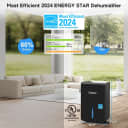
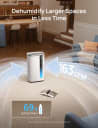
hOmeLabs Dehumidifier 7,000 Sq Ft 50 Pint (MAX 120 Pint at 95°F, 90% RH)
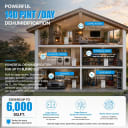
- Rated for spaces up to 7,000 square feet
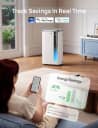
- Remote adjustment through Wi-Fi
- Continuous-drain hose outlet
- Two fan speeds, including Turbo
available at

Big, damp rooms call for more than a tiny bucket and a hopeful button. Learn which capacity, coverage, and drainage details matter before you buy.
Large rooms need a dehumidifier sized for the space and the dampness—not just the biggest pint-per-day number on a box. Start with the coverage rating, check the conditions behind the moisture-removal figure, and decide whether you want remote controls or hands-free drainage.
Coverage is a useful first filter. A rating near 7,000 square feet gives you more headroom than ratings around 2,500 to 6,000 square feet, especially in an open or connected area. Treat any advertised area as an estimate: high ceilings, closed-off rooms, leaks, and persistent dampness can all affect how well a unit manages the space.
Read pint ratings alongside their test conditions. A dehumidifier’s daily capacity changes with temperature and relative humidity, so a number measured in hot, very humid air can be much higher than one measured in typical indoor conditions. For a more useful comparison, look for capacity around 80°F and 60% relative humidity; don’t compare that figure directly with a rating taken at 95°F and 90% RH.
Remote control is a convenience, not a capacity upgrade. Wi-Fi can be handy if you want to change settings without walking to a basement or garage, and some app-connected models also report energy use. If you’re comfortable using the controls on the unit, prioritize appropriate capacity and drainage instead.
Continuous drainage can save frequent trips to the tank. A hose connection is most useful when the unit sits near a floor drain or sink; check whether the hose is included and whether gravity can carry water to the drain. A pump-enabled design can move water upward, but don’t assume a standard hose outlet can do that.
A larger tank means fewer emptying trips, not more moisture removal. Tank capacity and pint-per-day capacity measure different things. If there’s no convenient drain, look for a clear full-tank alert and automatic shutoff, and consider how easy the tank will be to lift and empty.
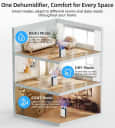
Choose for the dampest space you need to manage. A large basement with recurring moisture usually needs more capacity than a similarly sized, mildly humid living area. If your home has several enclosed rooms, a single coverage figure doesn’t guarantee that air will circulate well through every doorway.
Plan where the water will go before you buy. Measure the route to a drain and check the outlet’s placement, hose requirements, and any limits on hose length or lift. If the unit will run unattended, automatic shutoff and restart behavior are worth checking in the listing.
Think about where the unit will run. Noise ratings are useful when provided, but listings don’t always state them using comparable methods. For a bedroom or living area, look for a low or sleep mode and read customer feedback for recurring comments about sound; for a basement or garage, convenience and drainage may matter more.
Don’t let a high-condition capacity number settle the decision. Ratings taken at very high heat and humidity can make different units look more alike—or more powerful—than they are in everyday conditions. Compare the same conditions where possible, then weigh coverage, drainage, and the controls you’ll actually use.
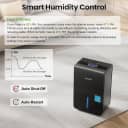
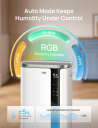
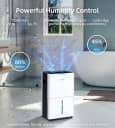
Set a target and let the sensor do its job. Many units let you choose a target humidity and cycle the compressor as conditions change. A built-in reading is convenient, but if the room still feels damp, check for water intrusion or blocked airflow rather than assuming a different setting will solve the underlying problem.
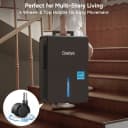
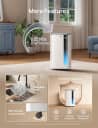
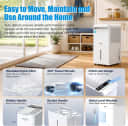
Keep the air path clear. Leave space around the intake and outlet, and clean a washable filter as the instructions recommend. Wheels and handles make it easier to reposition a heavy appliance, but check the unit’s dimensions before deciding where it will fit.
Use moisture absorbers for small enclosed spots, not whole large rooms. Hanging bags can help with odor and moisture in a closet, vehicle, or stored boat, but they are not a substitute for an electric dehumidifier when you need sustained moisture removal across a large area.
Confirm the details that affect day-to-day use. Check whether the drain hose is included, how large the tank is, and whether the unit has automatic shutoff, restart, and a washable filter. If energy use, app controls, or warranty coverage matters to you, verify those specific details in the current listing rather than relying on a general claim.
Favor a rating that matches your room, not an extreme-condition headline. For a large area, a higher coverage rating and a substantial capacity figure at moderate test conditions offer a more relevant starting point than an impressive maximum alone. Add Wi-Fi if remote adjustment would genuinely help, and choose drainage that suits the layout.

Swipe to compare all 8 picks →
| At a glance | 1 hOmeLabs 7,000 Sq Ft Dehumidifier![]() | 2 Gasbye DryPrime-50 Dehumidifier![]() | 3 AEOCKY Dehumidifier with Pump![]() | 4 DREO Smart Dehumidifier![]() | 5 Vellgoo DryTank Pro Dehumidifier![]() | 6 Aiusevo 52-Pint Dehumidifier![]() | 7 VEAGASO 34-Pint Dehumidifier![]() | 8 Better Boat Moisture Absorber Hanging Bags![]() |

|---|---|---|---|---|---|---|---|---|
| Our score | 9.9/10 | 9.6/10 | 9.3/10 | 9.0/10 | 8.7/10 | 8.4/10 | 8.1/10 | 7.8/10 |
| Buyer rating | 4.2 | |||||||
| Coverage Area | 7,000 sq ft | 4,500 sq ft | 4,500 sq ft | 2,000 sq ft | 6,000 sq ft | 5,000 sq ft | 2,500 sq ft | 0.6 sq ft |
| Moisture Removal | 50 pints/day | 115 pints/day | 80 pints/day | 73 pints/day | 140 pints/day | 52 pints/day | 34 pints/day | 0.5 pints/day |
| Wi-Fi Control | Yes | No | No | Yes | No | No | No | No |
| Continuous Drainage | Yes | Yes | Yes | Yes | Yes | Yes | Yes | No |
| Buy |