BLUETTI
BLUETTI Apex 300 Portable Power Station & B500K Expansion Battery 7884.8Wh
- 7,884.8Wh listed bundle capacity
- Simultaneous 120V/240V output
- 3,840W AC output with 7,680W surge
- AC, solar, car, and generator charging
available at

A power station can keep essentials running through an outage—but only if its capacity, output, and charging options match your needs. Use this guide to compare the numbers that matter and avoid paying for power you can’t use.
A home-backup power station is most useful when it can run the appliances you care about for as long as you need them. Start with your essential loads, then compare capacity, output, and recharge options—not just the number of ports.
Battery capacity sets your energy budget. Measured in watt-hours (Wh), it helps estimate how long the station can supply power: a 100W device running for five hours uses about 500Wh, before conversion losses. A higher capacity is useful for longer outages or several appliances, and an expansion battery can add stored energy if the system supports one. Check whether a listing’s capacity includes an expansion battery.
Continuous output determines what can run at once. Compare the station’s AC output in watts with the running-watt requirements of your appliances. Add together the loads you expect to power simultaneously, and leave headroom rather than planning to operate at the limit. A higher number can accommodate more demanding combinations of household essentials.
Surge output matters when motors start. Refrigerators and some other appliances can briefly draw more power at startup than they use while running. Check the appliance’s startup requirement against the station’s stated surge output, as well as its continuous output. A strong surge rating does not increase the station’s stored energy or its continuous capacity.
Solar input affects how quickly you can replenish power off-grid. A higher maximum input can accept more solar charging, provided your panels and setup are compatible. Look for whether a listed maximum applies to the base station or requires expansion, and remember that actual charging varies with sunlight, panel positioning, and other conditions. If you primarily recharge from a wall outlet, compare AC charging time instead.
Cycle rating offers a longevity clue, not a lifespan guarantee. Listings may state how many charge cycles a battery can complete before it retains a specified share of its original capacity. Compare both the cycle count and that capacity threshold; a higher count with no threshold stated is harder to assess. Battery age, storage, temperature, and use can also affect long-term performance.
Choose the outage plan before choosing the capacity. List the devices you want to power, their wattage, and how many hours you need them to run. Prioritize essentials such as a refrigerator, lights, communications, or medical equipment, then estimate energy needs by multiplying watts by hours. Treat the result as a planning estimate: real runtime depends on the load, conversion losses, and operating conditions.
Separate energy needs from power needs. Capacity in Wh is about how long a station can provide energy; output in W is about how much it can provide at one time. A station can have plenty of stored energy but still be unable to start an appliance whose power demand exceeds its output or surge limit. Check the appliance labels or manuals, especially for motor-driven equipment.
Match the outlets to the way you plan to use the station. Some home equipment requires 240V, while many everyday devices use 120V. If you need both voltages during an outage, confirm that the station supports the required voltage and whether it can supply both at the same time. Count the outlets you will actually use, and check for USB or DC ports if you want to avoid adapters.
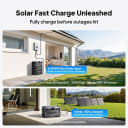
Think through how you’ll restore power. Wall charging is convenient when the grid is available; solar, car, or generator charging can offer alternatives when it is not. Compare the stated input limits and recharge times, and verify that any panels, cables, or expansion batteries you need are included or compatible. A bundled solar panel’s wattage is not necessarily the same as the station’s maximum solar input.
A UPS feature is for brief interruptions, not whole-home backup. A stated switchover time can matter for equipment such as a computer or router that should not lose power when the grid cuts out. Check the listing’s transfer-time claim and whether the feature suits your equipment; it does not replace a properly configured home backup system. For hardwired circuits or whole-home integration, consult a qualified electrician.
Portable stations are best matched to selected circuits or appliances. Their stored energy is finite, so running high-draw appliances for long periods can use it quickly. They are not a substitute for a permanent backup system unless the installation and equipment are specifically designed for that use. Keep the station in a suitable location and follow the manufacturer’s charging, storage, and safety instructions.
Compare the complete setup, not just the power station. The capacity you need may call for an expansion battery, while solar recharging may require separate panels and cables. Check what comes in the box, the system’s compatibility notes, and where each component will fit at home. A realistic plan helps you spend on usable backup rather than headline specifications alone.
Swipe to compare all 8 picks →
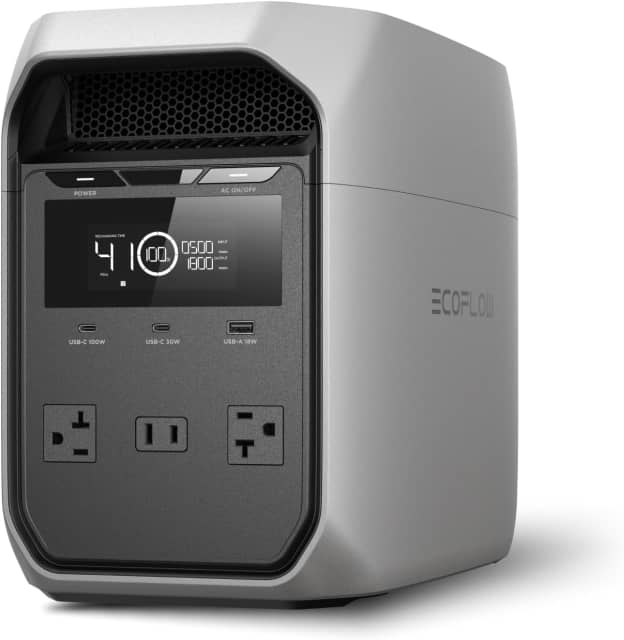
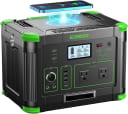
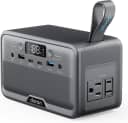
| At a glance | 1 BLUETTI Apex 300 + B500K Expansion Battery![]() | 2 VTOMAN FlashSpeed 2400 Power Station![]() | 3 Anker SOLIX S2000 Portable Power Station![]() | 4 Jackery Explorer 300 Portable Power Station![]() | 5 GRECELL EB500 Portable Power Station![]() | 6 EF ECOFLOW DELTA 3 Classic Power Station![]() | 7 ALLWEI Portable Power Station 300W![]() | 8 Daran 89.6Wh Portable Power Station![]() |
|---|---|---|---|---|---|---|---|---|
| Our score | 9.9/10 | 9.6/10 | 9.3/10 | 9.0/10 | 8.7/10 | 8.4/10 | 8.1/10 | 7.8/10 |
| Buyer rating | 4.2 | |||||||
| Battery Capacity | 7,884.8 Wh | 1,408 Wh | 2,010 Wh | 292 Wh | 519.5 Wh | 1,024 Wh | 256 Wh | 89.6 Wh |
| Continuous Output | 3,840 W | 2,400 W | 1,500 W | 300 W | 500 W | 1,800 W | 300 W | 100 W |
| Surge Output | 7,680 W | 3,200 W | 3,000 W | 600 W | 1,000 W | 3,600 W | 600 W | 200 W |
| Solar Input | 6,400 W | 600 W | 400 W | 100 W | 100 W | 500 W | 100 W | 40 W |
| Cycle Rating | 6,000 cycles | 3,000 cycles | 10,000 cycles | 4,000 cycles | 1,000 cycles | 4,000 cycles | 3,000 cycles | 3,500 cycles |
| Buy |